


I have my arms wrapped around a baby a lot lately. And shockingly, babies cry. Sometimes they cry to tell you something...sometimes they just cry. Regardless, the first instinctive thought you have as a parent is mostly the same: “Do something!” This is not my first baby rodeo, but that cry still triggers the impulse to immediately do something. It can be stressful (and loud). It also serves as a beautiful reminder.
Sometimes the moment looms large. Emotions run high, and it feels like you have to do something. This is the case when it comes to investment accounts. Something triggers that same, instinctive urge to do something. Elections, bad news about relationships from country ABC, currency talk, random financial gurus who insists the end is neigh…you pick the catalyst. Any of these things and a hundred others could be the metaphorical baby who cries and gets you to do something. Only with investments, that action could run counter to your original plan and set you back.
Keep in mind, this analogy only goes so far. There isn’t a lot of downside to trying to settle your newborn. When a baby cries, you pick up the distraught child and rock them and cuddle them and implement a loving kind of scientific method until that human fire alarm settles down. But the same idea holds true for both crying babies and investment worries: if you step back, you realize that the emotion (panic?) you feel is a fleeting moment in time. Step back enough, and you realize life is really good. Even if little Charlie might not think so for a few minutes.
So it is in the financial world. There are days where headlines are fear-inducing, inflation looks grim, or markets are simply in the red. If you are looking too close—if you are looking at mole hills every day—you start to think things are bad. The way our human minds work, the downs hurt more than the ups feel good.
Fortunately for me, I don’t have a commentator narrating every time baby Charlie starts to cry. Imagine how much worse it would be if someone was shouting “Baby absolutely distraught, father failing epically”, “Child reaching peak anger and turning purple, Conner unable to be good dad”, and “Baby on track for asphyxiation due to excessive screaming, nice job”. I do have an occasionally vocal (and always right) peanut gallery in my wife, but at least Brooke holds back a little.
In the financial world, commentating is commonplace. They shout constantly, making mountains out of mole hills. Many are paid to make those mountains. Reading headlines and hearing the commentators makes it seem even more urgent to do something—even if the best thing to do is step back and realize we are staring at a tiny bump on the path to success.
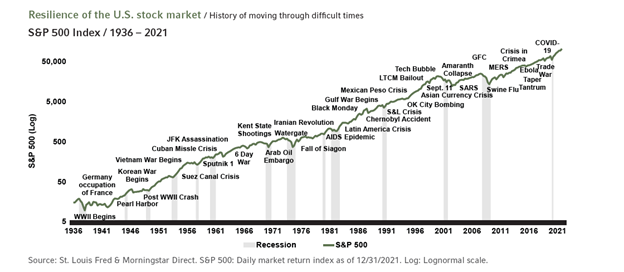
Look at that! World War II, 9/11, the Great Recession, and COVID all happened, amongst so many others, rocking our world. Through it all, the market has bounced, plummeted, tanked, and corrected its way to astronomical heights over time.
Of course, not all of us have fifty years to step back and watch money work anymore. But for all of our clients, we have a strategy in place—we have a plan. And if we stick to the plan, and invest based on timeline and patience rather than based on the metaphorical screaming baby, we have a much higher chance of success.
So what can you do? If stepping back and keeping the big picture in mind is ideal, what are some tools we have?
- Control your informational diet: You can still be informed, but be careful where you get your information, and how much you are digesting. Understand where entertainment meets information.
- Manage your mole-hill watching: don’t look at investment accounts daily. Try to look less often. Some of our happiest (and most successful) clients look every once in a while. Monthly, quarterly, or even less! They rely on us to tell them if there is something important to change, and they occasionally check in to see (and celebrate) progress.
- Right-size your expectations: We can do everything right and invest according to someone’s timeline, risk tolerance, goals, and life circumstance, and still have many down days, down months, and even occasional years where we lose money. Understanding that is critical to success—by knowing what could happen on a relatively short-term basis, we can better stick to the strategy.
- Understand your true timeline: One of the most common concerns I hear as an advisor is that someone “doesn’t have time” to weather a bad market again. These words often come from newly retired or soon-to-be retired, intelligent, thoughtful people. They understand a bad market could possibly derail their plans. What they may not realize is that they don’t need all their money at once! Part of their money, even if they are 60 or 65 years old, could have another 20-30 years before it needs to be available! With that kind of timeline, there is time to weather a few downturns for the sake of long-term results. As long as we have enough money invested conservatively that they can draw upon during down periods, they can still be well-positioned for a successful retirement and remain invested in equities as well.
So, relax, settle in, and enjoy the ride. Meanwhile, I look forward to the day when Charlie decides to communicate with words instead of angry goat wails.
DID YOU ENJOY THESE MUSINGS?
Subscribe to our monthly client newsletter to have future posts delivered to your inbox.